Homeland Security Group
Home Office directorate responsible for homeland security, counter-terrorism and related threats; successor to the Office for Security and Counter-Terrorism (OSCT); one of the seven agencies and departments forming the UK Intelligence Community; parent of RICU and other specialist units
| Homeland Security Group | |
| Abbreviation | |
|---|---|
| Type | Home Office directorate |
| Formation | |
| Predecessor | |
| Purpose | |
| Headquarters | Home Office, London |
| Parent organization | |
The Homeland Security Group (HSG) was created in April 2021 and is the new name for the Office for Security and Counter-Terrorism (OSCT) in the Home Office. Like the OSCT, the HSG is one of the “seven Agencies and Departments which form the UK Intelligence Community”.[1][2][3]
The other six agencies are:
- MI5 (the Security Service);
- MI6 (the Secret Intelligence Service);
- GCHQ (Government Communications Headquarters);
- Defence Intelligence in the Ministry of Defence;
- the Joint Intelligence Organisation (JIO) in the Cabinet Office;
- the National Security Secretariat (NSS) in the Cabinet Office.
History
The Office for Security and Counter-Terrorism (OSCT) was established in the Home Office in 2007. It emerged from a review of counter-terrorism strategy and operations that began in the aftermath of the August 2006 transatlantic aircraft plot. Responsibility for developing and governing the cross-government counter-terrorism strategy CONTEST was transferred from the Cabinet Office (where it had sat since 2003) to a new Home Office directorate. The move was driven in part by then-Home Secretary John Reid, who argued that the new body would have greater synergy with existing Home Office delivery functions (legislation, control orders, protective security, borders and contingency planning). Charles Farr, a former senior MI6 officer, was appointed the inaugural Director General in June/July 2007. The OSCT’s primary objective was to reduce the risk to the UK and its interests overseas from international terrorism so that people could go about their daily lives freely and with confidence, working through the four CONTEST workstreams of Pursue, Prevent, Protect and Prepare.[4][5][6]
Under Farr the OSCT coordinated the reappraisal of Prevent (building on earlier Preventing Violent Extremism / Pathfinder work), expanded local and international delivery, and became widely regarded in Whitehall as an intelligence agency. It managed the Home Secretary’s statutory relationship with the Security Service and led the cross-government organised-crime strategy as well as CONTEST. Farr stepped down in December 2015 to become Chairman of the Joint Intelligence Committee. Thomas Hurd succeeded him in April 2016 and led the OSCT until March 2021.[7][8]
On 1 April 2021 the Home Office restructured and the OSCT was renamed the Homeland Security Group. Chloe Squires became the first Director General for Homeland Security, leading the group through the transition. She was succeeded in 2025 by Michelle Haslem. The HSG retained the OSCT’s place as one of the seven agencies and departments that form the UK Intelligence Community and continued to house specialist units including RICU, the Joint Security and Resilience Centre and the Cyber Policy Unit.[9][10]
Constituent bodies
- Research, Information and Communications Unit (RICU)
- Joint Security and Resilience Centre[11]
- Homeland Security Group Science and Technology Unit
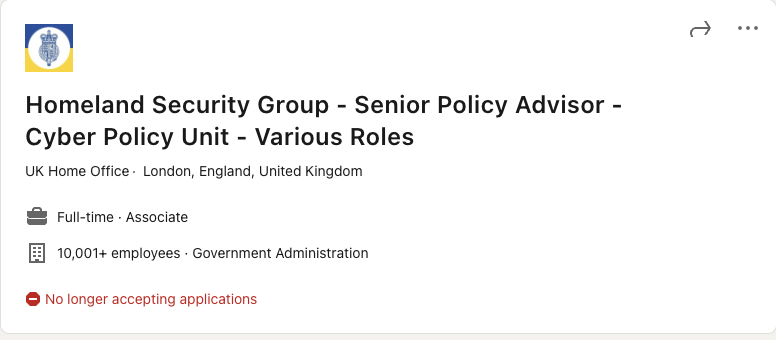
- Cyber Policy Unit[12]
People
Directors General
These officials are at the SCS3 pay grade, the third highest out of four.
- Charles Farr CMG OBE (June 2007 – December 2015). Appointed as the inaugural DG upon the creation of the OSCT. He stepped down to become the Chairman of the Joint Intelligence Committee.
- Thomas Hurd CB (April 2016 – March 2021). Succeeded Charles Farr and led the OSCT for five years. He stepped down in early 2021, shortly before the directorate was renamed.
- Chloe Squires (1 April 2021 – 2025). The first to hold the title of Director General for Homeland Security. She led the group through its transition from the OSCT until her departure in 2025. She “has been with the Home Office since 2019 and has spent over a decade working across the national security community. Before joining the Home Office, she was Director of Strategy at the National Cyber Security Centre.”[13] “Prior to this appointment, she was Director National Security in the Home Office (from May 2019) and led on a range of national security issues including aspects of Counter Terrorism, the domestic response to Hostile State Activity, implementation of the UK’s Investigatory Powers Act and associated oversight mechanisms, the operational relationship with MI5 and the use of national security related immigration and disruption powers. After graduating with a degree in History from Oxford University, Chloe joined the UK Civil Service Fast Stream. She has spent most of her career working in the national security sphere on both domestic and international issues including stints in the FCDO and Cabinet Office. Amongst other areas she has led on NATO, national security legislation and compliance and crisis management. Cyber Security has been a theme throughout Chloe’s career, having jointly authored the UK’s first Cyber Security Strategy. She has since worked as both Director Cyber in the FCDO and as Director of Strategy, as part of the team who set up the UK’s National Cyber Security Centre in 2016 in GCHQ.”[14]
- Dr Michelle Haslem CMG (2025 – Present). The current Director General for Homeland Security, taking over the role in 2025 after previously serving as a Director General at the Foreign, Commonwealth & Development Office (FCDO). She is reportedly “a national security professional with 27 years’ experience gained from roles in the UK, Asia, the Middle East and Europe. Michelle served as a director general at the FCDO from 2019 until 2025.”[15]
Other staff
Directors
Directors are usually in the SCS2 pay grade.
- 2022–2025 – Andrew Scurry, Director State Threats and Cyber at Homeland Security Group, Home Office.[16]
- 2019–2025 – Duncan Tessier, Director Economic Crime, Homeland Security Group, Home Office.[17]
- Sept 2020–2026 – Michael Stewart, Director, Prevent and Counter-Extremism, Home Office.[18]
- 2021–2026 – Jonathan Sinclair, Director National Security, HSG, Home Office.[19]
Lower staff
- Chris Barrett Allen – Senior Policy Manager, Homeland Security Group, UK Home Office, Mar 2022 – Present.
- Strategy Lead – Joint Extremism Unit, Ministry of Justice UK, Jul 2019 – Mar 2022.
- Home Office:
- Head Of Secretariat (acting) – Office for Security and Counter Terrorism, Feb 2019 – Jun 2019.
- Deputy Head of Team (OSCT), Apr 2018 – Jun 2019.
- Parliamentary Desk Officer (OSCT), Oct 2017 – Apr 2018.
- Communications Officer – National Security Communications, Cabinet Office, Sep 2016 – Oct 2017.
- Programmes and Admissions Assistant, UCL, Sep 2015 – Sep 2016.[20]
- Leah Clarkson – Policy Manager, Homeland Security Group, Jan 2021 – Present.
- Formerly:
- Policy Adviser – Office for Security and Counter-Terrorism, Apr 2020 – Mar 2021.
- Grants Officer – Cancer Research UK, Jun 2016 – Jun 2017.
- Caseworker and Office Administrator for Sadiq Khan MP, House of Commons, Feb 2016 – Jun 2016.[21]
- Mahmuda Islam – Senior Strategy Advisor, Homeland Security Group, UK Home Office, London Area, United Kingdom, Jan 2023 – Present.
- Policy Advisor – Investment Security Risk, Department for Business, Energy and Industrial Strategy (BEIS), Full-time, Sep 2021 – Jan 2023, London, England, United Kingdom.[22]
- Kiah Rose Sheppard (she/they) – Commercial Lead (Homeland Security Group) at the Home Office.
- Commercial Lead, UK Home Office, Jul 2021 – Present.
- Commercial Manager, Home Office, Mar 2019 – Jul 2021. Assistant Commercial Manager for the NAS programme.
- Ministry of Justice UK, 3 yrs 7 mos:
- Category Manager, Apr 2016 – Mar 2019. Category lead for Photocopiers/MFDs across the MoJ estate.
- Commercial Manager, Sep 2015 – Mar 2019.[23]
- Raya Tsolova – Industry Secondee, UK Home Office, Part-time, Jan 2023 – Present. Part-time secondment into the Joint Security and Resilience Centre (JSaRC) | Homeland Security Group (HSG) | Home Office.[24]
- Joe Walters – Senior Policy Advisor, Cabinet Office, Full-time, Dec 2022 – Present, London, England, United Kingdom.
- Senior Policy Advisor (Homeland Security Group), UK Home Office, Full-time, Nov 2021 – Jan 2023.
- Policy Advisor (Cities & Local Growth Unit), Department for Levelling Up, Housing and Communities, Full-time, Oct 2020 – Oct 2021, Manchester, England, United Kingdom. Advisor within the economic shocks team.
- Freelance Journalist, Jun 2019 – Jul 2020. Investigative/Financial journalist published in Private Eye and Euromoney.
- Researcher (Hillsborough Inquiry), Independent Office for Police Conduct, Mar 2016 – Jun 2019, United Kingdom.
- Intern, The Independent, Sep 2015, London, United Kingdom.[25]
Funding
Home Office data on spending by the Homeland Security Group and its predecessor, the OSCT, over £25,000 as disclosed by the Home Office is displayed in tables on the following pages:
- OSCT funding 2010
- OSCT funding 2011
- OSCT funding 2012
- OSCT funding 2013
- OSCT funding 2014
- OSCT funding 2015
- OSCT funding 2016
- OSCT funding 2017
- OSCT funding 2018
- OSCT funding 2019
- OSCT funding 2020
- OSCT/Homeland Security Group funding 2021
- Homeland Security Group funding 2022
- Homeland Security Group funding 2023
- Homeland Security Group funding 2024
See also
- Office for Security and Counter-Terrorism
- Research, Information and Communications Unit
- Prevent
- Joint Security and Resilience Centre
- Charles Farr
- Thomas Hurd
- Chloe Squires
- Michelle Haslem
External links
- Civil Service World (April 2021)
- Intelligence and Security Committee – How the Committee works (archived)
- Home Office announcement of Chloe Squires (7 April 2021)
- GOV.UK biography of Michelle Haslem
- CSaP profile of Chloe Squires (archived)
- Joint Security and Resilience Centre – Our Position
- Home Office spending disclosures (OSCT / Homeland Security Group tables, 2010–2024)
Notes
- ↑ Civil Service World, April 2021.
- ↑ Intelligence and Security Committee of Parliament, How the Committee works. Retrieved from the Internet Archive of 11 March 2020.
- ↑ Intelligence and Security Committee of Parliament, How the Committee works. Retrieved from the Internet Archive of 15 June 2022.
- ↑ House of Commons Home Affairs Committee, Minutes of Evidence, 26 February 2009 (Charles Farr).
- ↑ GOV.UK biography of Charles Farr.
- ↑ Home Office, “About us” (archived 2010).
- ↑ GOV.UK, “New Director-General for Office of Security and Counter Terrorism appointed”, 21 January 2016.
- ↑ Ian Cobain et al., “Inside Ricu, the shadowy propaganda unit inspired by the cold war”, The Guardian, 2 May 2016.
- ↑ Civil Service World, April 2021.
- ↑ Home Office, “New Director General for Homeland Security announced”, 7 April 2021.
- ↑ JSaRC Our Position. Accessed 6 September 2022.
- ↑ LinkedIn Homeland Security Group - Senior Policy Advisor - Cyber Policy Unit - Various Roles. Job advert. Screengrab captured 6 September 2022.
- ↑ Home Office New Director General for Homeland Security announced: New head of Homeland Security took up the role at the beginning of April. Published 7 April 2021. Retrieved from Archive.today of 20 February 2022.
- ↑ CSaP Chloe Squires. Retrieved from the Internet Archive of 13 September 2021.
- ↑ GOV.UK biography.
- ↑ Parliamentary oral evidence session.
- ↑ Cityforum agenda.
- ↑ Policy Exchange report.
- ↑ LinkedIn.
- ↑ LinkedIn archive.
- ↑ LinkedIn archive.
- ↑ LinkedIn archive.
- ↑ LinkedIn archive.
- ↑ LinkedIn archive.
- ↑ LinkedIn archive.